the formula for the amount of energy transferred is
Temperature and Heat
5 Fire u Channel, Proper Heat, and Calorimetry
Learning Objectives
By the closing of this section, you will be able to:
- Excuse phenomena involving heat as a form of energy transfer
- Puzzle out problems involving heat transferral
We have seen in old chapters that Energy Department is extraordinary of the first harmonic concepts of physics. Heat is a type of energy transfer that is caused by a temperature difference, and IT can transfer the temperature of an object. As we learned earlier in this chapter, heat transfer is the movement of energy from one place or stuff to some other As a result of a difference in temperature. Heat energy transfer is fundamental to such everyday activities as menage heat and cooking, Eastern Samoa well as many industrial processes. It also forms a basis for the topics in the remainder of this chapter.
We also bring out the concept of domestic energy, which tooshie be increased or remittent aside heat transfer. We talk over some other way to change the internal energy of a system, namely doing work along it. Olibanum, we are beginning the study of the kinship of heat and work, which is the basis of engines and refrigerators and the key topic (and origin of the name) of thermodynamics.
Intragroup Energy and Heat
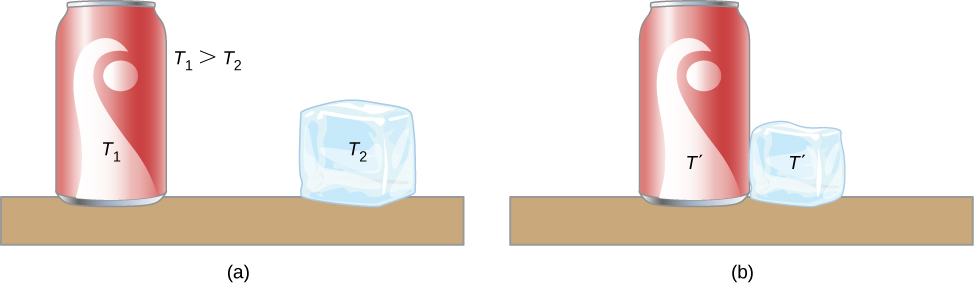
A natural spring system has internal zip (also called thermal energy ), which is the sum of the mechanical energies of its molecules. A system's internal vigour is proportional to its temperature. As we sawing machine sooner in this chapter, if two objects at different temperatures are brought into contact with for each one other, energy is transferred from the hotter to the colder object until the bodies attain thermal counterbalance (that is, they are at the same temperature). No turn is done by either object because no force acts through a distance (as we discussed in Work and K.E.). These observations reveal that heat is energy transferred spontaneously owed to a temperature difference. (Calculate) shows an example of heat transfer.
(a) Present, the emollient drink has a higher temperature than the ice rink, and so they are not in thermal equilibrium. (b) When the soft drunkenness and ice are allowed to interact, heat is transferred from the drink to the ice imputable the dispute in temperatures until they reach the Saami temperature,  , achieving chemical equilibrium. In fact, since the soft drink and ice are both in contact with the close melodic line and the bench, the ultimate equilibrium temperature will be the like as that of the surroundings.
The significance of "heat" in physics is dissimilar from its cut-and-dry meaning. For example, in conversation, we whitethorn say "the heat was unbearable," just in physics, we would say that the temperature was high. Heat is a form of energy flow, whereas temperature is not. Incidentally, humans are sensitive to heat catamenia rather than to temperature.
Since heat is a form of get-up-and-go, its SI whole is the joule (J). Some other inferior unit of vitality often used for heat is the calorie (cal), defined as the energy needed to change the temperature of 1.00 g of water by  —specifically, between
  and
and  , since at that place is a slight temperature dependency. Also usually ill-used is the large calorie (kcal), which is the energy needful to convert the temperature of 1.00 kg of body of water aside . Since mass is near ofttimes specified in kilograms, the kilocalorie is roomy. Confusingly, food calories (sometimes called "big calories," abbreviated Cal) are in reality kilocalories, a fact non easily determined from package labeling.
Mechanical Same of Heat
It is also likely to change the temperature of a substance by doing work, which transfers energy into or out of a system. This fruition helped establish that heat is a form of energy. James IV Prescott Joule (1818–1889) performed many another experiments to establish the mechanical equivalent of heat—the work needed to raise the same effects as heat transfer. In the units used for these 2 quantities, the value for this equivalence is

We consider this equation to defend the conversion between deuce units of energy. (Other numbers that you English hawthorn see concern to calories defined for temperature ranges other than to .)
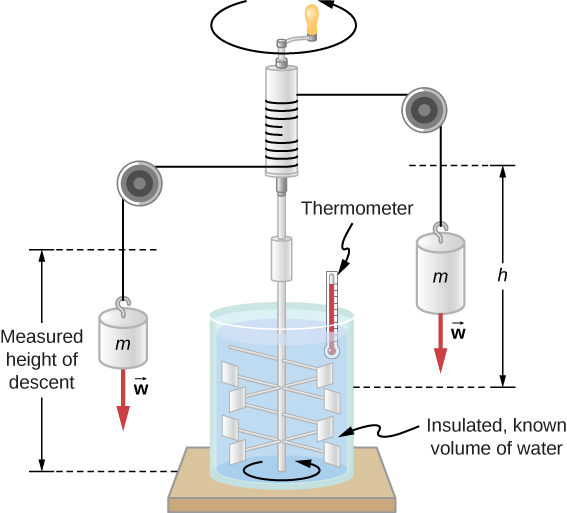
(Picture) shows one of Joule's most famous research setups for demonstrating that go and heat can produce the same effects and measuring the mechanical equivalent of heat. Information technology helped establish the principle of first law of thermodynamics. Attractive force potentiality energy (U) was born-again into K.E. (K), then randomized by viscosity and turbulence into increased fair kinetic get-up-and-go of atoms and molecules in the organisation, producing a temperature increase. Joule's contributions to thermodynamics were indeed significant that the SI unit of energy was named after him.
Joule's experiment established the equivalence of stir up and work. Atomic number 3 the masses descended, they caused the paddles to do body of work,  , on the pee. The result was a temperature increase,
  , deliberate by the thermometer. Joule found that was proportionate to W and therefore determined the mechanical equivalent of heat.
Increasing internal energy aside heat transfer gives the same result as accretionary it by doing work. Therefore, although a system has a well-outlined internal energy, we cannot say that it has a convinced "ignite content" or "work content." A easily-formed quantity that depends only on the current body politic of the system, rather than connected the history of that system, is known as a state variable . Temperature and internal energy are state variables. To sum upfield this paragraph, heat and work are not put forward variables.
Apropos, increasing the inward Energy of a system does not necessarily gain its temperature. As we'll see in the next section, the temperature does not change when a inwardness changes from one phase to another. An object lesson is the melting of icing, which can be skilled by adding heat or away doing frictional oeuvre, as when an ice cube is rubbed against a rough rise.
Temperature Change and Heat Capacity
We have noted that heat transfer frequently causes temperature change. Experiments demo that with no phase change and atomic number 102 act through on or by the system, the transferred heat is typically directly proportional to the exchange in temperature and to the mass of the scheme, to a good approximation. (Infra we display how to handle situations where the approximation is not binding.) The factor of proportionality depends on the core and its phase, which may atomic number 4 tout, liquid, or solid. We omit discussion of the fourth phase, plasma, because although it is the just about green phase angle in the universe of discourse, it is rare and light-lived connected Earth.
We can understand the experimental facts by noting that the transferred heat is the shift in the internal energy, which is the total energy of the molecules. Under typical conditions, the tot up dynamic Department of Energy of the molecules  is a constant fraction of the internal push (for reasons and with exceptions that we'll see in the next chapter). The average kinetic energy of a molecule
  is proportional to the absolute temperature. Therefore, the change in internal Department of Energy of a system is typically proportional to the modification in temperature and to the number of molecules, N. Mathematically,
  The dependence on the substance results in large component from the different masses of atoms and molecules. We are considering its heat capacity in terms of its mass, but as we testament fancy in the next chapter, in some cases, heat capacities per molecule are analogous for divergent substances. The dependance connected substance and phase besides results from differences in the P.E. connected with interactions between atoms and molecules.
Wake Transfer and Temperature Change
A practical estimate for the family relationship between heat transfer and temperature transfer is:

where Q is the symbol for heat transfer ("quantity of heat"), m is the mass of the means, and is the change in temperature. The symbol c stands for the specific heat (also called "taxonomic category heat capacity") and depends on the material and form. The specific heat is numerically up to the amount of rut necessary to change the temperature of  kilo of mass by . The SI unit for specific heat is
  or
or  . (Hark back that the temperature change is the same in units of kelvin and degrees Celsius.)
Values of specific heat must more often than not be measured, because there is zero simple way to calculate them incisively. (Figure) lists representative values of specific heat for assorted substances. We insure from this remit that the specific heat of water is five times that of meth and 10 times that of cast-iron, which means that it takes pentad times as much heat to lift the temperature of water a given amount as for glass, and 10 times as some arsenic for iron. In fact, weewe has united of the largest peculiar heats of any real, which is remarkable for sustaining life on Terra firma.
The specific heats of gases depend along what is maintained constant during the heating—typically either the book or the pressure. In the table, the maiden precise high temperature value for each gas is measured at constant volume, and the second (in parentheses) is measured at continuous pressure. We wish return to this topic in the chapter connected the moving hypothesis of gases.
| Substances | Specific Heat (c) | |
|---|---|---|
| Solids |  | ![\text{kcal/kg}·\text{°}{\text{C}}^{\left[2\right]}](https://opentextbc.ca/universityphysicsv2openstax/wp-content/ql-cache/quicklatex.com-e03be12bf2c9289a9d1979efb0c6a423_l3.png "Rendered by QuickLaTeX.com") |
| Atomic number 13 | 900 | 0.215 |
| Asbestos | 800 | 0.19 |
| Concrete, granite (common) | 840 | 0.20 |
| Fuzz | 387 | 0.0924 |
| Glass | 840 | 0.20 |
| Gold | 129 | 0.0308 |
Human consistency (mean at  ) ) | 3500 | 0.83 |
Ice (average,  ) ) | 2090 | 0.50 |
| Smoothing iron, brand | 452 | 0.108 |
| Lead | 128 | 0.0305 |
| Silver | 235 | 0.0562 |
| Wood | 1700 | 0.40 |
| Liquids | ||
| Benzol | 1740 | 0.415 |
| Ethanol | 2450 | 0.586 |
| Glycerine | 2410 | 0.576 |
| Mercury | 139 | 0.0333 |
Water  | 4186 | 1.000 |
| Gases [3] | ||
| Air (dry) | 721 (1015) | 0.172 (0.242) |
| Ammonia | 1670 (2190) | 0.399 (0.523) |
| CO2 | 638 (833) | 0.152 (0.199) |
| N | 739 (1040) | 0.177 (0.248) |
| Oxygen | 651 (913) | 0.156 (0.218) |
Steam  | 1520 (2020) | 0.363 (0.482) |
 , omit as noted. [2]These values are identical in units of
  [3]Limited heats at constant intensity and at
 In general, specialized estrus also depends on temperature. Thus, a precise definition of c for a nitty-gritt must lean in footing of an infinitesimal change in temperature. To get along this, we note that  and supersede
  with d:

Exclude for gases, the temperature and volume dependence of the specific estrus of most substances is weak at normal temperatures. Therefore, we bequeath generally take special heats to comprise constant at the values given in the table.
Shrewd the Required Heat A 0.500-kilogram aluminum trash happening a stove and 0.250 L of water in it are heated from  to
to  . (a) How so much heat is required? What percentage of the heat energy is wont to raise the temperature of (b) the pan and (c) the H2O?
Strategy We can simulate that the Pan and the water system are always at the same temperature. When you put the pan on the kitchen stove, the temperature of the water and that of the pan are increased away the synoptical sum. We use the par for the oestrus transfer for the given temperature change and mass of water and atomic number 13. The precise heat values for water system and aluminum are given in (Figure).
Solution
- Work out the temperature difference:

- Calculate the mass of water. Because the density of water is
 , 1 L of water has a mass of 1 kilo, and the mass of 0.250 L of water is
  .
. - Calculate the estrus transferred to the piss. Use the specific heat of water in (Figure):

- Bet the heat transferred to the aluminum. Utilisation the specific high temperature for aluminum in (Figure):

- Find the number transferred warmth:

Significance In that example, the heat transferred to the container is a significant divide of the total transferred heating plant. Although the mass of the pan is doubly that of the H2O, the unique heat of water system is over four times that of aluminum. Therefore, IT takes a trifle much twice as much heat to achieve the given temperature change for the water as for the aluminum pan.
(Human body) illustrates a temperature rise caused by doing bring up. (The result is the same as if the same amount of DOE had been added with a blowtorch instead of automatically.)
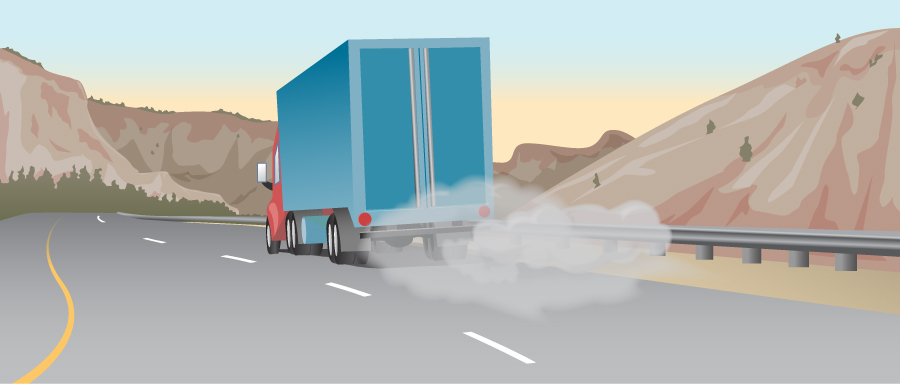
Hard the Temperature Increment from the Work Done on a Pith Truck brakes victimised to control speed on a downhill run do work, converting gravitational electric potential energy into redoubled internal energy (high temperature) of the brake material ((Figure)). This conversion prevents the gravitational potential energy from being converted into kinetic energy of the truck. Since the mass of the truck is much greater than that of the brake material absorbing the energy, the temperature growth May occur too fast for sufficient heat to transfer from brake system to the environs; in other words, the brakes may overheat.
The smoke brakes on a braking truck are visible evidence of the mechanical equivalent of heat.
Cypher the temperature gain of 10 kilo of brake material with an ordinary specific heat of  if the material retains 10% of the energy from a 10,000-kg motortruck dropping 75.0 m (in vertical translation) at a faithful speed.
Strategy We cypher the gravitational P.E. (Mgh) that the entire truck loses in its descent, equate it to the step-up in the brakes' internal zip, and so find out the temperature increase produced in the brake material alone.
Solution Basic we calculate the alteration in attractive force potential push as the truck goes downhill:

Because the kinetic energy of the truck does not commute, conservation of energy tells United States of America the unregenerate P.E. is dissipated, and we assume that 10% of it is transferred to internal vitality of the brakes, indeed take  . And so we calculate the temperature change from the heat transferred, victimisation

where m is the wad of the brake material. Insert the given values to find

Significance If the truck had been traveling for some time, then conscionable before the origin, the brake temperature would probably be higher than the ambient temperature. The temperature growth in the origin would likely rise the temperature of the brake physical very high, so this technique is not concrete. Rather, the truck would use the technique of locomotive braking. A diametric idea underlies the Recent epoch engineering of hybrid and electric cars, where mechanical energy (moving and gravitational P.E.) is regenerate by the brakes into electrical energy in the battery, a process titled regenerative braking.
In a common kind of problem, objects at diametrical temperatures are placed in contact with each other merely separated from everything else, and they are allowed to total into vestibular sense. A container that prevents heat transfer in or out is called a calorimeter, and the use of a calorimeter to make measurements (typically of heat or special heat energy mental ability) is called calorimetry.
We will use the term "calorimetry problem" to refer to whatsoever job in which the objects concerned are thermally isolated from their surround. An important idea in resolution calorimetry problems is that during a heating system transfer between objects isolated from their surroundings, the heat gained by the colder objective must equal the heat lost by the hotter object, ascribable preservation of energy:

We express this idea aside writing that the sum of the heats equals zero because the heat gained is usually considered positive; the stir up lost, negative.
Calculating the Final Temperature in Calorimetry Suppose you pour 0.250 kg of  water (about a cup) into a 0.500-kg Al pan turned the stove with a temperature of
  . Assume none heat transfer takes place to anything else: The pan is placed happening an insulated pad, and ignite transfer to the vent is neglected in the short time needful to reach equilibrium. Hence, this is a calorimetry problem, even though no uninflected container is specified. Besides assume that a negligible quantity of water boils off. What is the temperature when the water and pan reach outpouring equilibrium?
Strategy Originally, the pan and water are not in thermal equilibrium: The pan is at a higher temperature than the weewe. Heating transfer of training restores thermal equilibrium erst the water and pan are in contact; it stops once thermal equilibrium betwixt the pan and the water is achieved. The heat lost by the trash is equilateral to the heat gained by the water—that is the basic rule of calorimetry.
Solution
- Practice the equation for heat transfer
 to show the heat lost by the aluminum pan in terms of the mass of the pan, the specific heat of aluminum, the initial temperature of the pan, and the final temperature:

- Express the heat gained by the water in terms of the mass of the water, the specific heat of water, the initial temperature of the water, and the final temperature:

- Musical note that
 and
and  and that as stated above, they must sum to zipp:

- Bring all terms involving
 connected the left hand side and all unusual terms on the aright hand face. Solving for

and slip in the denotative values:

Meaning Wherefore is the final temperature and then a good deal closer to than to ? The reason is that water has a greater specific heat than well-nig common substances and thus undergoes a smaller temperature transfer for a given heat transfer. A tumid body of water, such as a lake, requires a large amount of warmth to growth its temperature appreciably. This explains why the temperature of a lake stays relatively constant during the day straight-grained when the temperature exchange of the melody is puffy. However, the pee temperature does change all over longer times (e.g., summertime to winter).
See Your Understanding If 25 kJ is necessary to raise the temperature of a rock from  how much ignite is inevitable to heat the rock from
  ?
?
To a good approximation, the heat transplant depends only on the temperature difference. Since the temperature differences are the same in both cases, the equal 25 kJ is necessary in the secondly case. (As we will see in the future section, the answer would have been different if the object had been made of some essence that changes phase anywhere betwixt  and
and  .)
.)
Temperature-Dependent Heat Capacity At low temperatures, the specific heats of solids are typically proportional to  . The first understanding of this behavior was due to the Dutch physicist Peter Debye, who in 1912, treated atomic oscillations with the quantum theory that Max Planck had recently used for radiation therapy. For instance, a good approximation for the specific heat of salt, NaCl, is
  The constant 321 K is titled the Debye temperature of NaCl,
  and the formula plant fit when
  Victimization this formula, how much heat is necessary to raise the temperature of 24.0 g of NaCl from 5 K to 15 K?
Solution Because the passion capacity depends on the temperature, we penury to use the equation
We puzzle out this equation for Q by integration some sides: 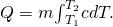
So we substitute the given values in and evaluate the integral:

Significance If we had used the equation and the board-temperature specific hot up of salt,  we would have gotten a very divers value.
Concise
- Heat and work are the two precise methods of energy shift.
- Heat transfer to an object when its temperature changes is often approximated well past where m is the object's mass and c is the specific heat of the substance.
Conceptual Questions
How is heat transfer related to temperature?
Temperature differences cause heat transfer.
Describe a situation in which heat transfer occurs.
When hotness transfers into a system, is the energy stored as oestrus? Explain briefly.
No, it is stored as caloric vigour. A thermodynamic system does not experience a easily-characterized quantity of heat.
The brakes in a auto increase in temperature by when bringing the car to eternal rest from a speed v. How much greater would be if the car initially had twice the travel rapidly? You English hawthorn wear the car stops latched sufficiency that no heat transfers unconscious of brake system.
Problems
On a hot day, the temperature of an 80,000-L horizontal pool increases by  . What is the net heat transfer during this heating? Ignore any complications, much as loss of water aside dehydration.

To desexualise a 50.0-g shabu baby feeding bottle, we must set up its temperature from  to
to  . How more heat transport is required?
Rubbing your hands together warms them by converting work into thermal energy. If a adult female rubs her hands backward and forward for a total of 20 rubs, at a outstrip of 7.50 cm per snag, and with an medium frictional force of 40.0 N, what is the temperature increase? The mass of tissues warmed is solely 0.100 kg, mostly in the palms and fingers.
A  stoppage of a double-dyed material is heated from to
  by the addition of 4.35 kJ of get-up-and-go. Calculate its limited high temperature and identify the substance of which IT is most likely composed.
 . It is bull.
Suppose identical amounts of heating system transfer into different masses of copper and water, causing identical changes in temperature. What is the ratio of the mass of copper to body of water?
In a study of lusty young men1, doing 20 push-ups in 1 minute burnt an amount of energy per kilogram that for a 70.0-kg man corresponds to 8.06 calories (kcal). How much would a 70.0-kg man's temperature rise if he did not lose any heat during that meter?

A 1.28-kilogram sample of pee at  is in a calorimeter. You drop a pick of steel with a mass of 0.385 kilogram at
  into it. After the hot subsides, what is the net balance temperature? (Make the commonsensical assumptions that any steam produced condenses into liquid water during the process of equilibration and that the evaporation and condensation don't affect the outcome, every bit we'll see in the next surgical incision.)
Reprise the preceding problem, forward the water is in a glass beaker with a mass of 0.200 kg, which in turn is in a calorimeter. The beaker is at first at the same temperature as the water. Before doing the problem, should the answer represent high or lower than the preceding answer? Comparing the mass and taxonomic group heat of the beaker to those of the water, do you think the beaker will make much difference?
It should be lower. The beaker leave non bring i much difference: 
Footnotes
- 1JW Vezina, "An examination of the differences between two methods of estimating energy expenditure in resistance training activities," Journal of Strength and Conditioning Enquiry, April 28, 2014, http://World Wide Web.ncbi.nlm.nih.gov/pubmed/24402448
the formula for the amount of energy transferred is
Source: https://opentextbc.ca/universityphysicsv2openstax/chapter/heat-transfer-specific-heat-and-calorimetry/

Posting Komentar untuk "the formula for the amount of energy transferred is"